
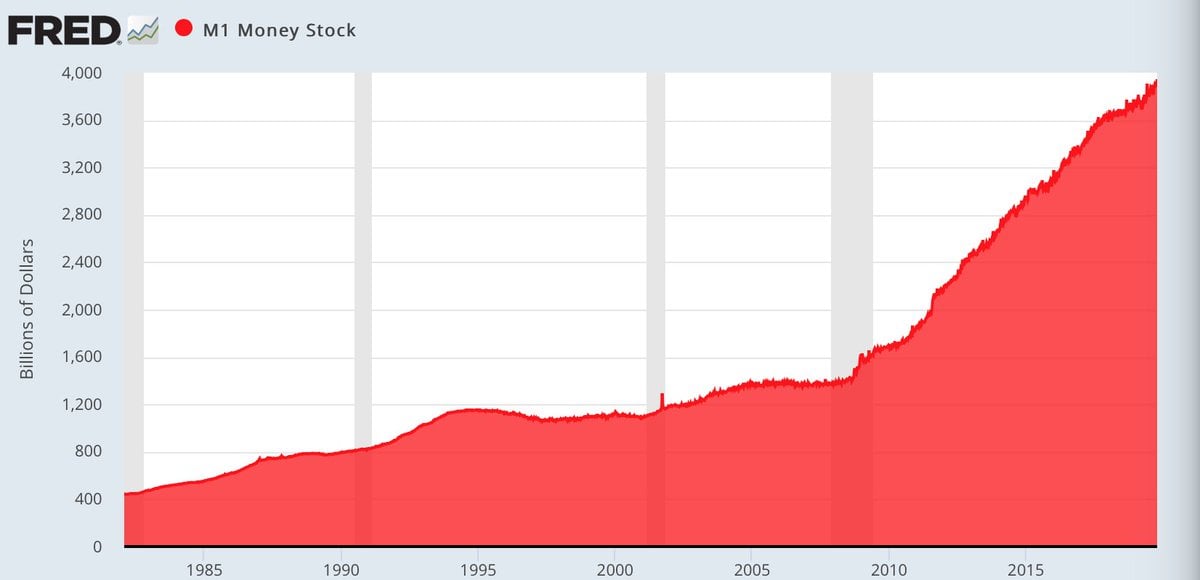
The global economy seems to be heading toward a financial crisis fueled by central planners that could devastate markets worldwide. This year onlookers are witnessing the largest synchronization of central banks printing massive amounts of fiat or participating in other forms of stimulus. The central banks’ easing policy hasn’t been this colossal in nearly two decades as the M1 money supply has touched an all-time high.
Also read: Why Central Banks Are Not Designed for Democracies
Expect More Easing as Central Banks Continue Fighting the Fires They Started
The central banks continue to print enormous amounts of fiat, slash rates, and do what they can to curb the devastating consequences of poor central planning. In 2019, the number of developed central banks bolstering easing policies makes it seem like a large-scale concerted effort. For instance, almost two dozen central banks are playing the roulette table by manipulating the global economy in a number of ways. Initially, when the gloomy economic forecasts started becoming a serious topic, the banks simply began cutting interest rates. A slew of institutions from regions like Japan had already been reducing interest rates and introducing negative rates as well.
The Federal Reserve is derelict in its duties if it doesn’t lower the Rate and even, ideally, stimulate. Take a look around the World at our competitors. Germany and others are actually GETTING PAID to borrow money. Fed was way too fast to raise, and way too slow to cut!
— Donald J. Trump (@realDonaldTrump) October 24, 2019
The Federal Reserve cut rates for the first time this summer since the economic crisis of 2008 and cut them again in September. Despite the influx of $60 billion a month plus overnight repos, U.S. President Donald Trump still thinks the Fed could do better. All of the banks are citing rising inflation and lack of liquidity while at the same time acting surprised by the deep economic slump. For instance, on October 24, Ukraine’s central bank cut rates by 100 basis points. The Ukrainian monetary policy committee concluded that “inflationary pressures” have been too much and agreed to the easing.

The following day on October 25, the European Central Bank (ECB) and the People’s Bank of China (PBoC) executed a bilateral currency swap agreement. The ECB and PBoC have been participating in a variety of easing processes this year and explained the bilateral currency swap aims to strengthen forex and capital markets. The deal is the second three-year extension and the first deal was drafted in 2013. After the initiation of massive synchronized easing efforts worldwide, JP Morgan strategists have written a research note telling investors that they should expect even more monetary easing policies in the future. “The evolution of the macro outlook, the risk of spillover from the corporate to the household sector or from manufacturing into services warrant some caution, especially in the context of the lingering risks from trade war and Brexit, with the U.S. Presidential election later in the year,” JP Morgan’s analyst said.

While the Era of Central Banking Crumbles, Liberty and Free Market Solutions Will Reign
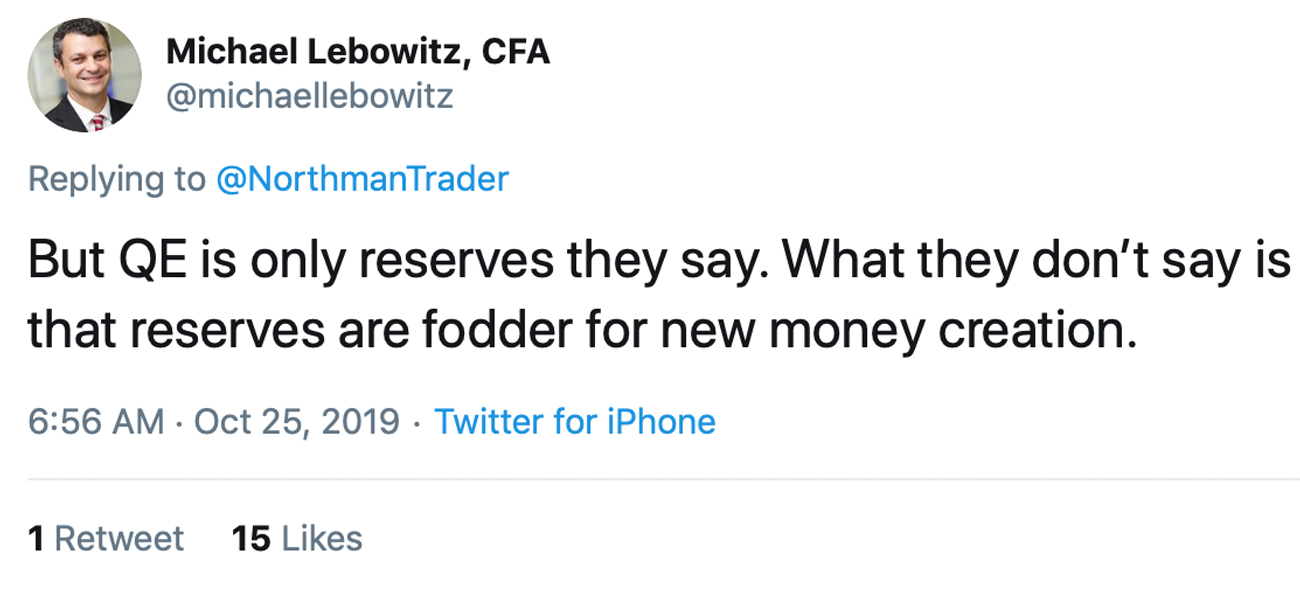
Sven Henrich, the founder of Northmantrader.com, a blog about macroeconomics and technical analysis, detailed this week that the M1 money supply has touched an all-time high and the Federal Reserve “keeps cranking.” “We can all speculate on the who’s and how’s, but one can note that M1 money supply magically suddenly gets kicked into high gear expansion once stocks get into trouble … The expansion since 2009 vs the historic run rate has been breathtaking,” Henrich said. “Perhaps this is the biggest underreported and undiscussed issue out there. I can’t pretend to fully understand it but I’m curious to hear why money supply has increased 4 fold since 2000 and was virtually flat for years during 2004-2008 and only since 2009 has been on this rip higher.” Henrich further stressed:
Yet they say there are not enough dollars around for overnight funding and that’s why they’re doing repos?
On October 28, at the Litecoin Summit in Las Vegas, retired U.S. statesman Ron Paul told the crowd that the era of central banking is crumbling and free market solutions like precious metals and cryptocurrencies offered a path toward liberty. “Liberty is the answer to so many of our problems — Liberty is not divisive, the government can not come in and work it out,” Paul explained. “People have to come together and work together.” The former presidential candidate added:
The American empire is on its last leg — It’s going to be rough.
With all the banks working together to fix what they have started, many economists believe they still will fail. Since the 16th century, central banks have increased the quantity of money in order to tackle the rising price of goods and services. The money supply increase has ultimately reduced the common person’s purchasing power using legal tender issued by the central banks. In 1958, Ludwig Von Mises’ lecture “Economic Policy: Thoughts for Today and Tomorrow” revealed how bureaucrats wholeheartedly believe “that bankers had some secret knowledge enabling them to produce wealth out of nothing.”
Instead, politicians and central bankers have caused rapid inflation, divided global citizens with class warfare, and continue to fund the military-industrial complex with no end in sight. In Ron Paul’s book “End the Fed,” the former senator’s words will be forever etched into the minds of young people striving for more liberty. “It is no coincidence that the century of total war coincided with the century of central banking,” Paul wrote at the time. So far, Paul and many other economists have been right about the central bank’s fraudulent acts, but no one truly knows if they can keep the long con going for much longer.
What do you think about the large scale easing efforts being promoted by central banks these days? Do you think they are just digging a bigger hole? Let us know what you think about this subject in the comments section below.
Image credits: Shutterstock, Twitter, Sven Henrich, Fred, Fair Use, and Pixabay.
Did you know you can buy and sell BCH privately using our noncustodial, peer-to-peer Local Bitcoin Cash trading platform? The Local.Bitcoin.com marketplace has thousands of participants from all around the world trading BCH right now. And if you need a bitcoin wallet to securely store your coins, you can download one from us here.
The post More Filthy Fiat: Two Dozen Central Banks Ramp up the Printing Presses appeared first on Bitcoin News.
source https://news.bitcoin.com/more-filthy-fiat-two-dozen-central-banks-ramp-up-the-printing-presses/
Komentar
Posting Komentar